Last Updated on 4 months
Exploring the Basics of Tire Sizing
When you’re checking out the size of your vehicle’s tires, it’s best to look at the inscriptions on the tire itself instead of just relying on the owner’s manual. That way, you’ll get the most accurate information.
The exterior of a regular tire is decorated with codes and numbers that show its size, structure, and manufacturing specifics. Some inscriptions may not be vital for you as a driver, but are essential for finding the right replacement tires.
The sidewall of a tire in the United States features a combination of numbers and letters that indicate the tire’s dimensions. The standard tire size in the U.S. is 205/55R16, but a range of sizes is available. It is essential to check the tire size on your vehicle or refer to the vehicle’s manual to ensure you’re using the correct dimensions.
If you’re looking for new tires, it’s a good idea to familiarize yourself with the different markings on tires. These details are essential in choosing a suitable replacement for your vehicle to ensure safety and compatibility.
Tire Size Meanings
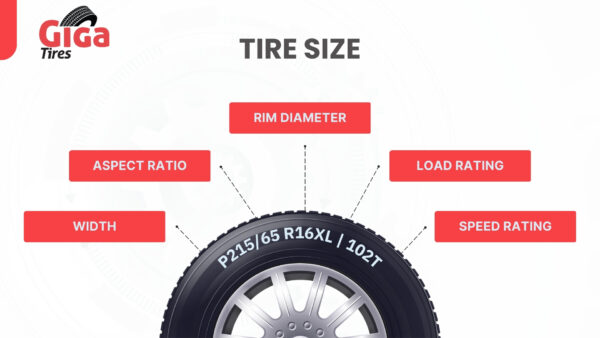
The alphanumeric sequence on a tire’s sidewall determines its kind of tire and whether it fits your vehicle well. Here’s a brief guide to decoding these specifications:
Tire Code
When you look at the tire code, you’ll see a helpful alphabetic prefix that helps categorize the tire. This prefix is vital in identifying the tire’s design and intended use.
- ‘P’ means that the tire is specifically designed for passenger vehicles. These tires are designed to meet U.S. standards for P-metric sizing. They are suitable for vehicles like cars, minivans, SUVs, and some light-duty pickups, with specific load index considerations for these vehicle classes. It is essential not to overlook this classification during tire selection.
- ‘L.T.’ denotes a tire designed for light trucks. These tires are perfect for vehicles that carry heavy loads, do towing, or need robust tire options. These tires are usually found on giant trucks and SUVs, meeting the LT-metric sizing requirements for heavy loads.
- ‘S.T.’ is an abbreviation for Special Trailer Tires. This classification is for tires specially designed for trailers, including various trailers, from recreational fifth wheels to boat and utility trailers.
If there isn’t a leading alphabetic character, the tire is identified as metric or European-sized, with measurements in millimeters. Even though they may look similar to ‘P’ or ‘L.T.’ tires in dimensions, they might have different load capacities.
When getting new tires, paying attention to these designations is essential. That way, you can make sure the tires are a perfect match for your vehicle and will meet all its needs.
Tire Width
The initial three-digit numeral following any letters in the tire code represents the tire’s section width. This measurement, recorded in millimeters, spans the tire’s tread from one sidewall to another when viewed head-on.
Consider the sequence of numbers that follows the initial letter(s). This helps measure the tire’s tread width from one side to the other. For instance, if we examine the P225/60R16 95S and LT235/75R15 96H sequences, the “225” and “235” represent the tread widths of 225mm and 235mm, respectively. Thus, a more significant number means a wider tire.
Aspect Ratio
The slash symbol separates the tire width from the aspect ratio, a two-digit number. The aspect ratio, the profile, shows the sidewall’s height relative to the tire’s width. It is shown as a percentage, illustrating the sidewall’s height from the rim to the tread’s peak relative to the section width.
A lower aspect ratio, like 55 or below, means the sidewall height is shorter. This usually improves the vehicle’s handling and steering accuracy.
Construction Type
A single letter indicates the tire’s construction type, which provides information about the tire’s internal structure.
- ‘R’ corresponds to popular radial tire construction, commonly used for most modern tires. Radial tires are great because they have fantastic traction, help you save fuel by reducing rolling resistance, and are super comfy and long-lasting. A radial tire is made by carefully placing ply cords that are strengthened with polyester, steel, and fabric covered in rubber and arranged so that they are at right angles to the tire’s travel direction.
- ‘D’ represents diagonal construction, known as bias tire construction. These tires have plies layered in a diagonal pattern, often called conventional, X-ply, or cross-ply tires. Bias construction is still standard in specific motorcycle and trailer tires.
Tires with run-flat capability are sometimes identified by an ‘F’ followed by a letter indicating the type of internal construction.
Radial Tire Construction Indicator
Following the aspect ratio in the tire code, ‘R’ is often used to indicate radial construction, which is quite common. The ‘R’ in the tire’s name means that the tire is made with its ply cords extending radially across the tire, from one bead across the tread to the other bead, perpendicular to the tire’s rotation axis. This radial arrangement is integral to the performance of modern tires.
Wheel Diameter
When looking at tire specifications, the width and diameter are usually the main measurements that come to mind. However, it’s important to remember that many factors influence tire selection for your vehicle. These factors include your driving patterns and personal preferences.
The alphanumeric series on the tire sidewall is a helpful guide that provides all the tire’s essential specifications.
To explain tire interpretation in a friendly way, let’s talk about tire specifications, which are indicated by:
P225/60R16 95S and LT235/75R15 96H.
Within these sequences, the wheel diameter is indicated by a two-digit number reflecting the size in inches. This figure shows the distance between the wheel from one bead seat to the other, the points where the tire is meant to fit tightly onto the wheel.
Load Index
The numerical sequence after the space in a tire’s code represents the load index, a significant indicator of a tire’s weight-bearing capability. This index is aligned with a standardized chart, providing the maximum load a tire can carry.
For instance, a load index of 89 means that the tire is designed to support up to 1,279 pounds as long as it is inflated to its recommended air pressure. The load index is crucial because it helps ensure the tire can handle everything your vehicle needs without problems.
Speed Rating
The concluding letter in a tire’s alphanumeric identification string signifies its speed rating. This rating tells you the maximum speed at which the tire can safely operate for a long time. Tires with a superior speed rating are specially designed to handle heat better and provide better control when driving at higher speeds. The fastest speed a vehicle can go is limited to the tire’s speed rating, with the lowest rating out of all the tires it has installed.
About the examples provided (P225/60R16 95S and LT235/75R15 96H), the ‘S’ speed rating indicates the tire is tested for safe operation at speeds up to 112 mph, while the ‘H’ rating is tested up to 130 mph. These ratings don’t recommend specific driving speeds, but they give you an idea of how well the tire can handle different speeds when needed.
Tires with higher speed ratings generally yield better handling characteristics. You are getting new tires for your vehicle with speed ratings that match or exceed the original tires. This will help keep your car performing well and ensure your safety on the road. In cases where tires on the vehicle have different speed ratings, the safe maximum speed of the car is defined by the lowest tire speed rating.

What’s a Tire’s profile?
The profile of a tire, also known as the aspect ratio, refers to the sidewall’s height, which is the vertical wall of the tire. This parameter is a ratio defined as a percentage of the tire’s total width.
For instance, a 205/40R17 tire has a sidewall height of 40% of its 205mm width. Tires with a 50% or less profile are considered low profile; in some cases, they can be as little as 30% for ultra-low profile tires. Usually, cars designed for high performance come with tires that have a lower profile.
Lower-profile tires enhance control and provide a more responsive handling experience, particularly when navigating corners. However, this can result in a stiffer ride. It is important to note that reducing the profile of tires on wheels with the same diameter can lead to inaccuracies in speedometer readings.
Therefore, adjustments are necessary to ensure the speedometer displays the correct speed. If you need help choosing the right tire profile for your vehicle, you should talk to a tire specialist. They can guide you based on your vehicle’s specifications and help you find a well-performing tire.
How do tire sizes work?
Navigating the figures and characters on your vehicle’s tires can be challenging. These inscriptions, known as tire codes, are fundamental in identifying the exact dimensions and types of tires compatible with your vehicle.
Having the right size tires ensures your vehicle runs smoothly and stays safe. Calculating the correct wheel offset is necessary to get your tires in the proper position and ensure your car performs at its best.
Let’s examine a detailed exploration of each segment within the tire code to improve your understanding:
- This initial character may not be present on all tires, but when it is, it offers insight into the vehicle’s compatibility. Common indicators include ‘P’ for Passenger vehicles, ‘L.T.’ for Light Trucks, ‘S.T.’ for Special Trailers, and ‘T’ for Temporary spares.
- The first numerical trio reflects the tire’s cross-sectional width in millimeters, indicating the broadest segment of the tire’s side without any lettering or designs (“nominal section width”).
- After the slash that serves as a divider is a numeric value that can be two or three digits long and depicts the tire’s profile. This figure shows the sidewall height as a percentage of the tire’s width. When this number is missing, the default aspect ratio is typically 82%. If this number exceeds 200, it tells you the tire’s diameter in millimeters instead of the aspect ratio.
- An additional letter might follow, signifying the tire’s internal construction. With ‘R’ for Radial construction being the current standard, it’s worth noting that the cord plies in this structure are arranged at 90 degrees to the direction of movement. Other possible designations are ‘D’ for Diagonal construction and ‘B’ for Bias Belted, with the default being Diagonal construction if no letter is displayed.
- The sequence concludes with a numeric representation of the wheel diameter, measured in inches. Certain instances may provide this measurement to the nearest half-inch and, less commonly, in a three-digit form representing the diameter in millimeters.
With the tire code thoroughly deciphered, you possess the expertise to select tires with informed precision. In addition to this guide, you may find our fuel cost calculator beneficial, as the wheel offset tool aids in tire sizing.
When there is no alphabetic prefix, assuming that the tire has a diagonal construction is expected. The measurement that signifies the wheel’s diameter is traditionally expressed as either a one or two-digit figure in inches, directly corresponding to the wheel size the tire intends to fit.
Occasionally, this diameter may be specified to the precision of a half-inch increment. It is a less common practice, but a three-digit number can be used to indicate the diameter of a wheel; this format means the diameter in millimeters.
This explanation will help you better understand tire codes and dimensions. If you find the insights here helpful, you might also like our fuel cost calculator. It’s an excellent tool for assessing your vehicle expenses.

How To Read Your Tires
A tire’s initial trio of numerals indicates its section width, measured in millimeters (mm).
- After the width, you’ll find a two-digit number representing the tire’s aspect ratio. This number helps calculate the height of the sidewall as a percentage of the tread width.
- An ‘R’ in the sequence signifies a radial tire structure, whereas a ‘B’ signals a cross-ply or bias tire.
- After determining the construction type, you can find the wheel diameter that matches the tire by looking at a two-digit number representing inches.
When noting the size, remember that the load index is a two-digit number followed by a letter indicating the tire’s speed rating.
Interpreting a Tire Code on the Sidewall:
- ‘P’ indicates the tire is designed for passenger vehicles.
- ‘215’ details the tire’s width across the tread in millimeters.
- ’60’ denotes the aspect ratio, with the sidewall height being 60% of its width.
- ‘R’ confirms the tire is constructed with radial ply.
- ’16’ specifies that the tire fits a rim with a 16-inch diameter.
A tire marked as P215/60R16 translates to a passenger vehicle tire that is 215mm wide, with a sidewall height at 60% of its width, suitable for a rim of 16 inches in diameter.
Types of Tire Sizes
If you have customized your vehicle with tires and wheels different from the ones it came with, the specifications in the owner’s manual may not match the tires currently on your car.
After identifying your tire’s dimensions, the next step is to understand the details contained in those measurements.
Expert Insight: Tire dimensions are categorized into Metric (P-Metric), Flotation, and Numeric systems.
Every classification has a unique method of sharing tire specifications and is meant to give you clear information that suits your specific vehicle needs and driving situations.
1) Metric Sizing
Metric tire sizing is a widely used standard that includes three sets of numbers, along with designations such as “P” for passenger vehicles, “L.T.” for light trucks, and “R” for radial construction.
- Illustrative Instances: 235/75-15, P235/75-15, 235/75R15, LT235/75R15
- Width Measurement: The initial figure indicates the tire’s cross-sectional width in millimeters, taken from one sidewall to the opposite.
- Aspect Ratio: The aspect ratio, the intermediary value, quantifies the sidewall height stretching from the rim to the tread’s summit. When you see a tire marked as 235/75-15, the sidewall height is 75% of its width.
- Wheel Diameter: The concluding numeral signifies the wheel’s diameter in inches, with the exemplified tire accommodating a 15-inch diameter wheel.
2) Flotation Sizing
Flotation tire sizes are typically seen on equipment such as trailers, agricultural machinery, small utility units, and all-terrain vehicles (ATVs)). These tires have a wider circumference than metric and numeric alternatives, requiring wider wheel fittings.
- Sample Designations: 31X9.5X16, 20X10X9, 26X8X12
- Unit of Measure: Dimensions for flotation tires are uniformly in inches.
- Height Indicator: The initial figure represents the tire’s vertical span, measured from the ground straight to the tire’s apex.
- Width Indicator: The secondary numeral represents the full breadth of the tire measured across the sidewalls, distinct from the tread’s width.
- Diameter Detail: The terminal digit reveals the diameter of the wheel, with an illustrative tire dimension tailored to a 16-inch wheel.
3) Numeric Sizing
Numeric sizing is a straightforward method of representing tire sizes utilizing a series of numbers. Understanding this system is critical to selecting the right tires for your vehicle’s needs.
- Application: Numeric tire sizes are frequently used for light trucks, sports utility vehicles (SUVs), commercial trucks, and agricultural machinery.
- Configuration: Such sizes are indicated by either a duo or trio of numerical figures.
- Illustrative Examples: 11-22.5, 8-19.5, 35X12.50-17
- Width Measurement: The first figure reflects the tire’s width across the sidewalls in inches. It’s important not to confuse this with measuring the tread’s width.
- Diameter Specification: The second figure represents the wheel diameter to which the tire is fitted, measured in inches.
- Dimensional Breakdown: When presented with three numerical figures, the sequence is as follows: tire height, tire width, and finally, wheel diameter, all in inches. For instance, in the example of 11-22.5, the wheel’s diameter is 22.5 inches.

Where to Find Your Vehicle’s Tire Size
Ensuring that your vehicle is equipped with the correct tire size and specifications is a significant aspect of maintaining its performance and safety. You can easily find the manufacturer’s suggested tire dimensions and related details for your vehicle in multiple ways:
- Sidewall Inspection: Examine the sidewall of your tires currently mounted on your vehicle. The size and ratings will be there if they meet your car’s specifications.
- Owner’s Manual Consultation: The vehicle’s owner’s manual is the primary resource for the manufacturer’s recommended tire size and related specifications.
- Door Jamb Label: Check the label on the driver’s side door jamb for information about your vehicle’s tire size.
- Glove Box and Fuel Hatch: You can also find this information inside your glove box door and the interior side of your gas tank hatch or cap.
Referring to these sources can help ensure that the tires on your vehicle meet the manufacturer’s recommendations for optimal performance and safety.
Figure Out Your Tire Size
Understanding the proper tire size for your vehicle is necessary for vehicle maintenance and is essential when obtaining quotes for tire replacement. Here’s a simple guide on how to know the correct tire dimensions for your specific vehicle:
NOTE: Acknowledge that each vehicle is designed with unique wheel specifications; therefore, it is essential to identify the tire size that matches your model.
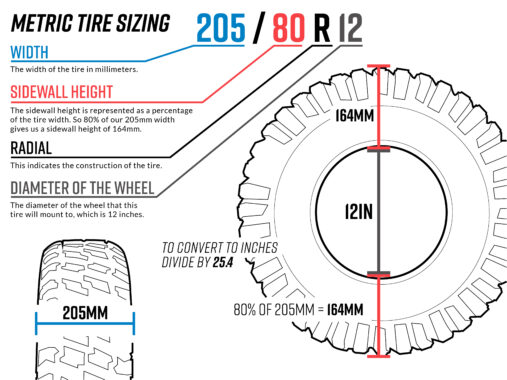
Matric Tire Sizing
Metric tire sizing, commonly called metric sizing, is a standardized system used globally to describe tire dimensions. This system includes three main components: the tire width, aspect ratio, and rim diameter, all measured in millimeters and inches. For example, a tire size of 205/80R12 breaks down as follows:
- 205: Tire width in millimeters, measured from sidewall to sidewall.
- 80: Aspect ratio, the height of the sidewall as a percentage of the tire’s width.
- R12: Rim diameter in inches, indicating the wheel size the tire fits.
This system helps ensure compatibility and performance for various vehicles by providing precise measurements for tire selection.
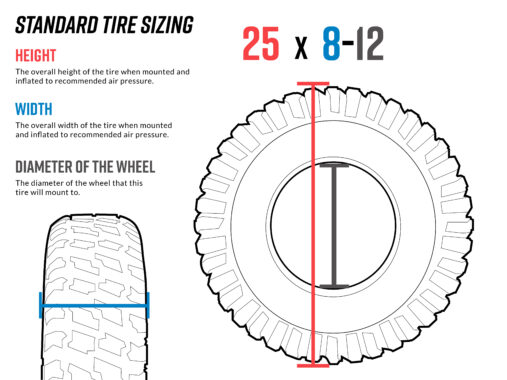
Standard Tire Sizing
Standard tire sizing, often known as inch-based sizing, is another method of identifying tire dimensions, primarily used in North America for certain types of vehicles, such as light trucks. This system typically includes three measurements: overall tire height, width, and wheel diameter, all expressed in inches. For instance, a tire size of 25 x 8-12 indicates:
- 25: Overall tire height in inches.
- 8: Tire width in inches.
- 12: Wheel diameter in inches.
Standard sizing is straightforward and commonly used for off-road and specialty tires, where the overall diameter is a crucial factor for performance and fitment.
By employing these methods, you can accurately identify the tire size that your vehicle’s manufacturer has recommended.
What Tire Size Do I Need?
The manufacturer carefully chooses your vehicle’s tire and wheel dimensions through a detailed engineering process. These dimensions determine the vehicle’s ride quality, fuel efficiency, braking efficacy, handling, steering responsiveness, and other integral aspects of the driving experience. Here are some things to consider:
- Manufacturer’s Optimal Specification: The original tire size specified by the vehicle manufacturer is deemed ideal for the vehicle’s intended performance and safety.
- Possibilities for Customization (‘Plus Sizing’): While it’s always a good idea to follow the manufacturer’s recommendations, there are times when you might want to customize your tire size for reasons such as aesthetic enhancements or functional upgrades.
If you’re considering changing your tire size, start by understanding the tire markings and how they match your vehicle’s needs. Understanding these factors is essential to maintain or enhance vehicle performance while making an informed decision.
Understanding Tire Width for Optimal Performance
The tire’s width significantly affects your vehicle’s performance, including handling, stability, and overall driving experience. Whether you’re a seasoned driver or just getting started, having a solid grasp of tire width will help you know how to choose the right tires for your vehicle. Here are some things that can help you understand your tire width:
- Enhanced Dry Traction: Wider tires generally enhance grip and improve cornering on dry surfaces, leading to superior handling.
- Rolling Resistance Considerations: There is a trade-off, as extensive tires may increase rolling resistance, potentially reducing fuel efficiency.
- Optimal Cornering Balance: A tire’s contact patch influences cornering capabilities; however, an overly broad tire may lead to a heavier and less responsive steering experience.
- High-Performance Vehicles: Vehicles with significant horsepower may benefit from wider tires, which can improve grip during acceleration and reduce wheelspin.
- Potential for Wear: Tires exceeding the ideal width may contact the wheel wells, leading to premature tire wear due to friction.
- Winter Traction Strategy: Narrower tires are recommended for better traction in snowy conditions, given that they can cut through snow more effectively than more comprehensive options.
- Safety in Snow: While narrow tires can be helpful in winter, selecting a tire that is too small for the vehicle can compromise safety and handling stability.
Tire Height
Understanding tire height and aspect ratio is essential for optimizing your vehicle’s performance and safety. This section will explore the importance of tire height and how it can affect your ride comfort, handling, and fuel efficiency. Below are some things you should be aware of concerning tire height:
- Enhanced Clearance for 4WD: Owners of four-wheel-drive vehicles often favor taller tires to augment ground clearance. This can make it easier to drive off-road and navigate through rough terrain.
- Handling Dynamics: Incorporating taller wheels into a vehicle’s design may influence handling, potentially leading to increased body roll during swift, evasive maneuvers.
- Dimensional Compatibility: It’s necessary to ensure that the chosen height of wheels and tires is compatible with the vehicle’s wheel well space to prevent undesirable contact and subsequent wear.
Optimal Tire Sizing Guidance
Discover the critical factors in selecting the ideal tire size for your vehicle, balancing performance, safety, and longevity for an optimal driving experience.
- Tire Size Adjustment Principle: When selecting a new tire size, a common approach is to increase the tire width by one size and decrease the sidewall aspect ratio accordingly. This maintains the overall tire dimensions. For instance, if you switch from your current tire size of 195/60R15 to 205/55R15, you’ll have a tire that’s 10mm wider and slightly lower in profile while preserving the same load index.
- Online Calculation Tools: Online calculators simplify technical details and make choosing the correct tire size easier.
Considerations for Unsprung Weight
Unsprung weight is an essential factor that is often overlooked but significantly affects vehicle performance and handling. Here is how unsprung weight impacts your vehicle:
- Impact on Vehicle Dynamics: Automotive engineers pay close attention to unsprung weight, which refers to vehicle parts not supported by the suspension system. This includes the wheels, tires, and associated drivetrain components.
- Rotating Mass Effects: Components contributing to unsprung weight often form part of the vehicle’s rotating mass. When the rotating mass increases, acceleration needs more power, impacting vehicle responsiveness.
- Braking Dynamics: An increase in unsprung weight, such as with larger wheels and tires, can negatively affect braking efficiency due to the higher momentum the braking system must counteract.
Oversized Wheels and Tires
When you look into oversized wheels and tires, you’ll discover new opportunities to make your vehicle look great and perform even better. Here is how big wheels and tires are crucial to making the right choice for your needs:
- Speedometer Calibration: When you install bigger wheels, it’s essential to adjust your speedometer correctly. This way, it will show your speed accurately and help you avoid any issues with traffic violations.
- Suspension Modifications: For 4WD vehicles, upsizing to larger tires often necessitates the implementation of a lift kit. This can have a significant impact on your vehicle’s suspension. It might cause vibrations, strain your drivetrain, and even affect how well your vehicle handles. Just make sure everything is appropriately set up to avoid any problems.
- Vehicle Dynamics Systems Alignment: Increasing wheel size may interfere with calibrating the vehicle’s advanced safety systems, such as ABS, traction control, and stability control, potentially impairing functionality.
- Ride Comfort Implications: Switching to taller wheels paired with low-profile tires might make your ride experience a bit bumpier since they don’t provide as much cushioning against road imperfections.
- Handling Dynamics: Changes in the size of wheels and tires can alter the vehicle’s braking efficiency and cornering dynamics because of differences in the size of the contact patch and how the weight is distributed.
- Gear Ratio and Mechanical Stress: Larger wheels rotate more slowly for the same distance, affecting how the vehicle’s gears work. This change can sometimes put extra stress on hubs, spindles, and even the transmission, which could speed up wear and potentially cause mechanical issues.
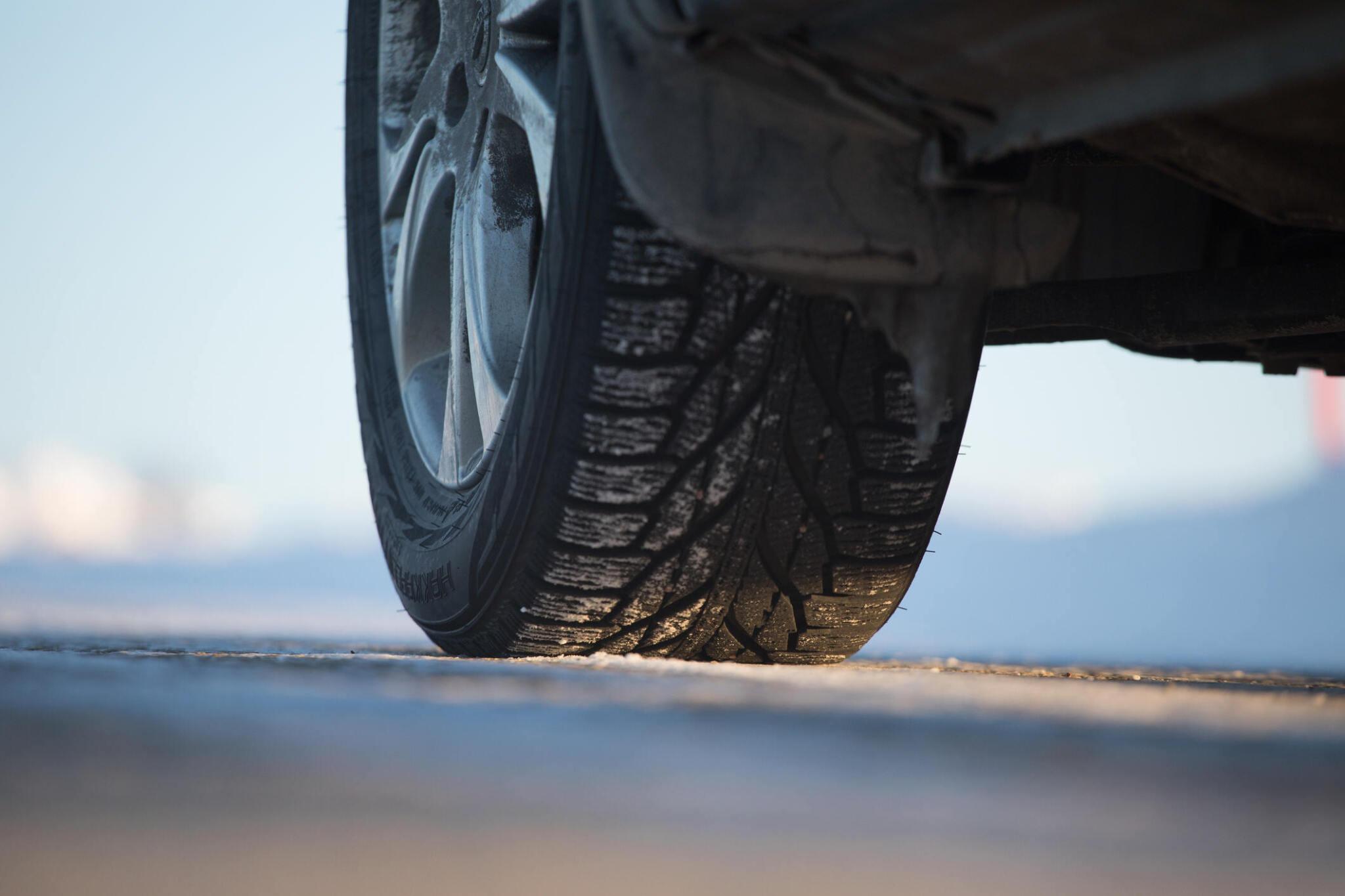
Identifying Compatible Tire Sizes
Identifying compatible tire sizes is essential for ensuring a smooth and hassle-free journey. Whether replacing worn-out tires or considering an upgrade, understanding compatibility is a good step toward having a good driving experience. Here is how to identify compatible tire sizes:
- Driver’s Door Jam Inspection: Open the driver’s side door and examine the door jam or panel for a label detailing the factory-installed wheel and tire specifications. This is a reliable reference for the original equipment tire dimensions.
- Verification on the Tire Surface: Inspect the actual tires on your vehicle. You will find a sequence of characters, such as “205/55R16,” representing the tire’s specifications. Ensure uniformity across all tires, and take note if the vehicle has staggered fitments, resulting in varied sizes between front and rear tires.
- Owner’s Manual Reference: While the owner’s manual is a credible source for tire size information, the most accurate methods are checking the driver’s door jam sticker and the tires themselves, especially if there have been any modifications or replacements since the vehicle was manufactured.
Assessing Suitable Tire Sizes for Rims
Ensuring that your tires and rims are compatible is required to keep your vehicle smooth, safe, and efficient. Here is how you can determine the right tire size for your vehicle’s rims:
- Rim Size Correlation: The dimensions of your vehicle’s rim help determine the best tire sizes for optimal performance. The rim width size chart is a helpful tool to compare different sizes.
- Example for 5-inch Rims: Referring to the chart, a 5-inch rim can accommodate a minimum tire width of 155 mm. For ideal performance, tire widths should range between 165 to 175 mm, with the maximum width capped at 185 mm.
- Informed Selection: While rim and tire width comparison charts are valuable tools, they are not definitive authorities. Professional consultation is advised for accurate tire compatibility and fitment. You can reach out to experts like those at JACK Mobile Tire for precise tire-to-rim fit verification.
Reasons to Change Tires
Changing tires is a regular part of taking care of your vehicle, and there are a few reasons why it’s essential. By understanding the reasons below, you can take proactive steps to manage your tires better:
- Maintenance Schedule: Tires should be replaced every three to four years, depending on driving habits and mileage.
- Performance Enhancement: Besides regular maintenance, changing your tires can help improve your vehicle’s performance!
- Aesthetic Preference: Styling considerations, such as a driver’s preference for vehicle appearance, may also influence the selection of new tires.
- Longevity Expectations: Opt for tire brands and models that are reputed to offer a lifespan that meets or exceeds the average replacement interval.
Tire Exchange for Enhanced Driving Performance
Your vehicle’s performance is closely connected to the quality and condition of its tires. Tires are essential because they’re the only thing keeping your car attached to the road. Swapping out your tires can lead to a noticeable improvement in your driving performance in the following ways:
- Diverse Tire Categories: Drivers can choose from different types of tires, each designed for specific driving conditions—namely, all-season, summer, winter, and all-weather tires.
- All-Season Tires: All-season tires are great for everyday use and offer a good balance of performance on different types of roads. However, they may not be the best choice for icy winter conditions because they can harden in low temperatures.
- Summer Tires are perfect for warmer climates, offering excellent traction on dry and wet roads. This is why they are favored among enthusiasts who drive high-performance vehicles.
- Winter Tires: Winter tires are great because they have unique compounds that keep them flexible even in frigid temperatures. It significantly enhances traction and reduces braking distances on snow and ice.
- Seasonal Tire Exchange: Vehicle owners often switch between summer and winter tires to align with seasonal weather patterns and road conditions for optimal safety and performance.
- All-Weather Tires: Although all-weather tires are certified for winter use, they might wear out faster than all-season tires over a year.
Aesthetics
Explore how upgrading wheels and tires can transform your vehicle’s appearance and performance while understanding the importance of expert guidance to ensure optimal fitment and functionality.
- Visual Impact of Wheels and Tires: Upgrading to larger wheels and tires is a popular way to enhance a vehicle’s visual appeal after a fresh coat of paint.
- Customization Options: Options such as wider tires or different sidewall dimensions can significantly alter the vehicle’s stance and profile. It’s good to ask an expert for advice on what would work best for your car.
- Consultation with Professionals: Before making changes, it’s always a good idea to contact tire installation experts. They can help ensure that your chosen tires are compatible with your vehicle and will not adversely affect its performance.
- Potential Risks of Incorrect Fitment: Using tires that are unsuitable for your vehicle might cause issues like incorrect speedometer readings and decreased driving quality. It could also affect your vehicle’s performance and potentially lead to more problems down the road.
Conclusion & Recommendations
When it’s time to replace your tires, the first step is to identify the correct size for your vehicle. The process is simple and essential for maintaining your vehicle’s performance. Below is a detailed guide, structured as per the bullet points from our table of contents, on how to find your tire size effectively:
- Check Inside the Driver’s Door: Open the driver’s side door and examine the door jamb for a tire specification sticker. This label will provide your vehicle’s precise size and other important tire information. It is the primary and most recommended method to confirm your tire size.
- Inspect Your Tire Sidewall: If the door sticker is missing or illegible, the next alternative is to read the tire size directly from the sidewall of your existing tires. Look for numbers and letters representing the tire width, aspect ratio, and rim diameter.
- Consult Your Vehicle’s Owner’s Manual: For additional confirmation, refer to your vehicle’s owner’s manual, which typically lists the original tire size specifications.
- Seek Professional Advice: When in doubt or if your vehicle has custom requirements, seek advice from a tire professional. They can provide personalized recommendations for your specific make and model.
- Online Tools and Resources: Use reliable online tire size calculators or guides to provide a secondary check for your tire size requirements.
After identifying your tire size through these steps, you can purchase an informed tire.
What Giga Tires Offers?
With the correct tire size, you can select from the finest range of tires available at Giga Tires. Whether you are searching for premium traction for rugged terrain or seeking a comfortable ride for daily commutes, Giga Tires offers a variety of options to suit your needs.
Click to browse our extensive collection and benefit from competitive pricing, exceptional customer service, and a streamlined purchasing process.
Let Giga Tires be your go-to destination for all your tire needs.
FAQs
What do the tire letters mean?
The tire letters provide information about the tire type and its purpose. For instance, ‘P’ stands for passenger vehicle tire, while ‘L.T.’ indicates a light truck tire. These letters can also mean the speed rating, such as ‘S’ for up to 112 mph and ‘T’ for up to 118 mph.
What do the tire numbers mean?
The numbers on the side of a tire represent its specifications, including width, aspect ratio, and diameter. For example, in ‘205/55R16’, ‘205’ is the width in millimeters, ’55’ is the aspect ratio as a percentage of the width, and ’16’ indicates the diameter in inches of the wheel it fits.
What tires do I need?
The tires you need depend on your vehicle’s requirements, driving conditions, and personal preferences. When selecting tires, it’s best to consult your vehicle’s manual and consider factors such as climate, road conditions, and performance needs.
How do I change a tire?
To change a tire, you’ll need to park and stabilize your vehicle safely, remove the wheel cover, loosen the lug nuts, lift the car with a jack, remove the lug nuts and tire, place the spare tire on, secure the lug nuts, and lower the car back down.
What do the numbers on the side of a tire mean?
The numbers on a tire’s sidewall represent its size, type, and performance capacity. They indicate the tire’s width, aspect ratio, construction type (R for radial), the diameter of the wheel it’s intended for, load index, and speed rating.
Where to find the tire size?
Tire size can typically be found on a sticker inside the driver’s side door jamb, in the vehicle’s owner’s manual, or on the tire’s sidewall. Using the correct size is essential for optimal vehicle performance and safety.
What’s my tire size?
Your tire size is indicated by numbers and letters on your tire’s sidewall or inside the driver’s side door on a sticker. It looks like “P205/55R16” and includes the type, width, aspect ratio, and diameter.
Tire size is a combination of width, aspect ratio, and diameter, represented by markings on your tire or information provided in your vehicle’s manual or on a label inside the driver’s door. This size is essential for proper fit and performance.
How do I find out my tire size?
You can find out your tire size by checking the sidewall of your current tires for a sequence of numbers and letters, looking at the sticker inside the driver’s side door, or consulting your vehicle’s owner’s manual for the correct specifications.